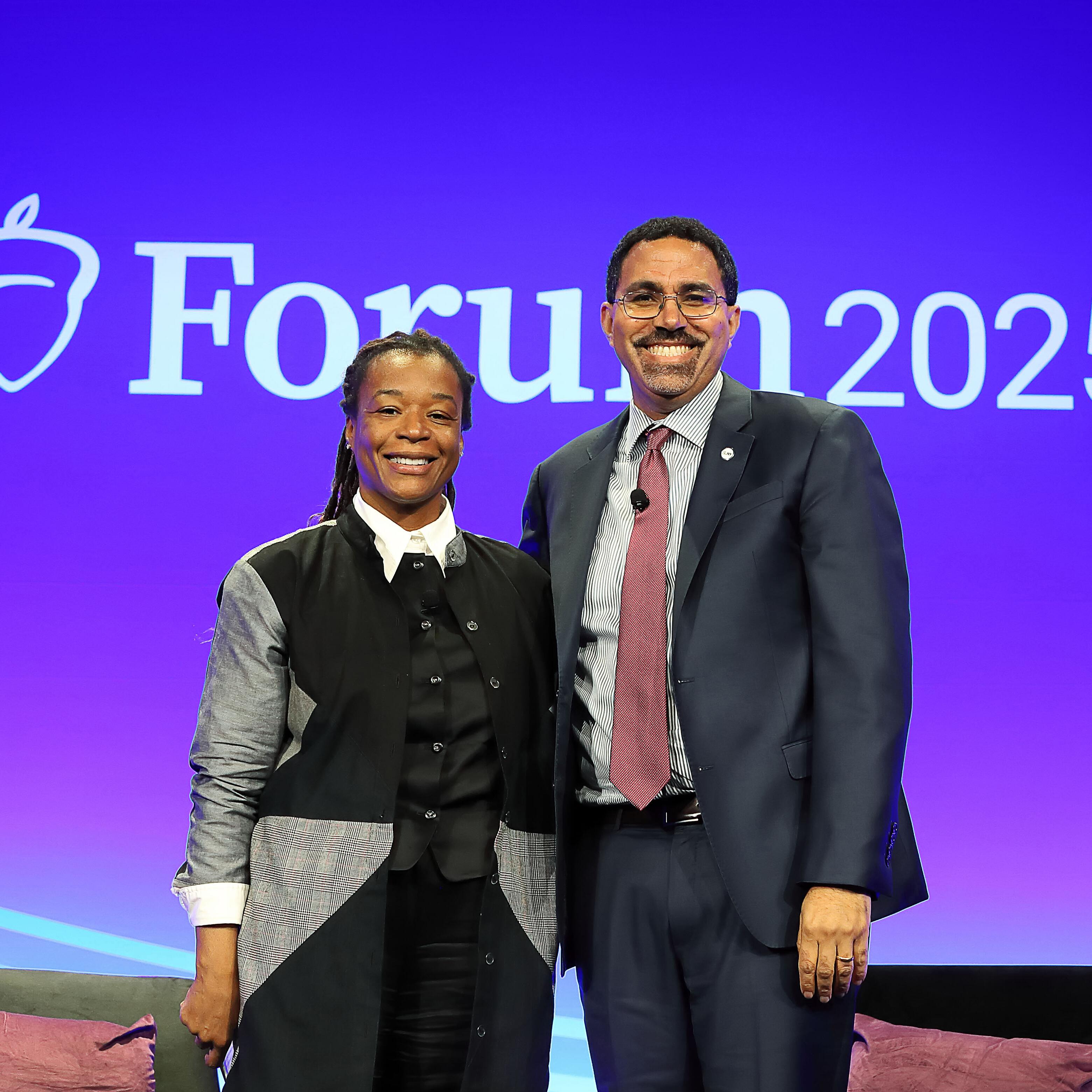
College Board Forum 2025
Policy as a Driving Force: Policy and Advocacy Roundtable on Career-Connected Education
Policy is a driving force, helping build systems that work for students and unlock opportunities.
That belief shaped the conversation led by our Policy and Advocacy team at College Board Forum. Leaders from education, workforce, and policy, including more than 10 groups ranging from CareerWise to the U.S. Chamber of Commerce, tackled an urgent question: How can we improve career-connected education for students through policy?
We designed the roundtable to surface shared challenges, illuminate bright spots, and generate new ideas for systems-level action. A clear consensus emerged: Helping students access meaningful, career-connected learning requires coordinated shifts in mindsets, systems, and structures.
Different Systems in Career-Connected Education Can Lead to Challenges
College Board CEO David Coleman kicked off the roundtable by sharing College Board’s commitment to making multiple paths to career success more visible and relevant. Building on our strengths in coursework, assessment, and exploration, we’re giving students more ways to develop and demonstrate career-relevant skills alongside academic skills. New AP® Career Kickstart™ courses in high-demand fields are supporting students in confidently pursuing their chosen path; strategic partnerships across sectors are advancing those opportunities in communities nationwide.
Across this work, leaders participating in the roundtable grappled with the many systems that shape students’ experiences, such as K–12, postsecondary, workforce, commerce, and human services, and the friction that often exists between them, such as:
- Misaligned mindsets: Many parents, educators, and community members still believe career-connected learning is limited to specific career paths or only for students who do not plan to attend a four-year college.
- Funding and resource gaps: Lack of resources can make it difficult for schools and districts to build sustainable pathway systems at scale.
- Instructional quality: Teachers need preparation, support, and time to deliver durable skills and deep, scaffolded learning.
- Changing labor markets: Employers are grappling with the shrinking half-life of skills and rapid changes driven by AI.
Without shared language, clear standards, or strong measurement tools, it becomes difficult for schools, intermediaries, and employers to align expectations and build systems that work for students.
Policy Solutions Can Advance This Work at Scale
Recognizing these challenges allowed the roundtable to surface concrete policy solutions. Participants identified increasing teacher flexibility, including modernized training and simplifying the credential process, as essential. The roundtable raised a need for deeper engagement between intermediaries and employers, as well as sector-wide standards and moving from one-off apprenticeships to sustainable systems nimble enough to respond to real-time skill needs.
The group also mentioned the importance of career lattices, not just ladders, to support students as they move through evolving industries. Other important levers include:
- Strengthening governance structures, such as Industry Advisory Committees
- Aligning Perkins funding and standards
- Expanding teacher externships
- Creating opportunities for students to earn credit and income through work-based learning
States Are Leading the Way: Maryland, Colorado, and South Carolina
Three states surfaced as examples of what large-scale change can look like. They demonstrate the impact of strong state-level frameworks that connect policy, funding, standards, and practice, as well as the importance of having clear metrics and outcomes that can help drive implementation.
- Maryland: The Blueprint for Maryland’s Future establishes rigorous college- and career-readiness expectations and sets ambitious goals for expanding pathways and apprenticeships statewide. Specifically, it sets a goal for all students to be college- and career-ready by the end of 10th grade and aims for 45% of public high school graduates to complete a registered apprenticeship or industry-recognized credential by 2030-31.
- Colorado: The state’s Quality and In-Demand Non-Degree Credentials Framework provides a rubric to evaluate credentials, ensuring value to job-seekers and employers and enabling stackable pathways rather than ad-hoc credentials.
- South Carolina: Through the Coordinating Council for Workforce Development (CCWD) and the Statewide Education and Workforce Development Act, South Carolina is aligning systems, setting shared outcomes, and promoting cross-sector collaboration.
When states, schools, employers, and intermediaries work together, students gain clearer pathways and more meaningful opportunities to explore their futures.