College Board Forum 2025
The Enrollment Cliff Is Looming. Here’s How College Leaders Can Prepare

Across much of the United States, the population of high school graduates is projected to plateau and decline in the years ahead. Colleges and universities are already thinking about how to respond.
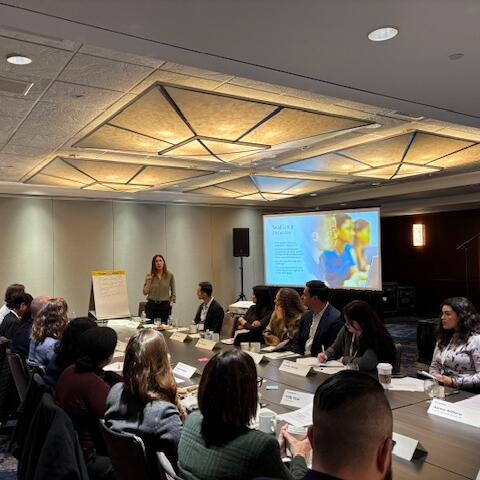
“The premise is not to scare people, but rather to think about these in the context of your institution, in the context of your state,” said Colleen Falkenstern, director of evidence and strategic initiatives, policy analysis and research at the Western Interstate Commission for Higher Education (WICHE). She was presenting alongside a pair of College Board researchers who are exploring the long-term implications of America’s declining birthrate and analyzing how educational institutions can bolster enrollment with fewer traditional students in the pipeline.
WICHE predicts that the national population of high school graduates peaked in 2025, with steady declines for the next 15 years. By 2041, the overall population of high school graduates will decline by 13%, presenting major challenges for colleges and universities trying to recruit from a dwindling pool. Many institutions are already shifting their enrollment strategies to make things easier for students.
“It’s not about changing the rigor of the admissions process, but changing how students think about the admissions process,” Falkenstern said. “Thinking about how we change the college-going culture.”
Removing barriers to enrollment can help bring more students into the fold, and many universities are already experimenting with direct admissions processes, where students who meet certain grade or test-score criteria are automatically granted admission, or waiving application fees. Universities will also need to be more proactive about reaching students who haven’t traditionally considered the college pathway, including low-income, first-generation, and rural students.
Falkenstern noted that high schools have made significant improvements in retention and graduation over the last couple of decades, helping to partially offset declining student populations that are college bound. Colleges can adopt a similar focus on retaining the students they admit.
Similarly, many institutions have begun to emphasize services for adult learners pursuing a degree to change careers or expand their opportunities. But Falkenstern pointed out that higher education is still tailored to the ideal of a full-time, recently graduated high school student. The needs of working adults are very different, she said.
“It really requires changes in how we schedule, how we support students,” she said. “It’s not as easy as just attracting [adult learners]; it’s also about building a system that’s made for them.”
The coming demographic decline will affect different parts of the country in different ways. The Southeast is the only region that is projected to see growth over the next 15 years, while the Northeast and Midwest will see sharp declines. Overall, 38 states are expected to have declining high school populations, with some of the largest drops concentrated in major cities.
College leaders should be clear-eyed and realistic about how to tackle these looming problems, Falkenstern said. As the WICHE report Knocking at the College Door advises, “There are proven approaches to increasing student access and success, especially for those whom higher education has not historically served well.”