Prepárate 2026
A Conversation with Tom Moore
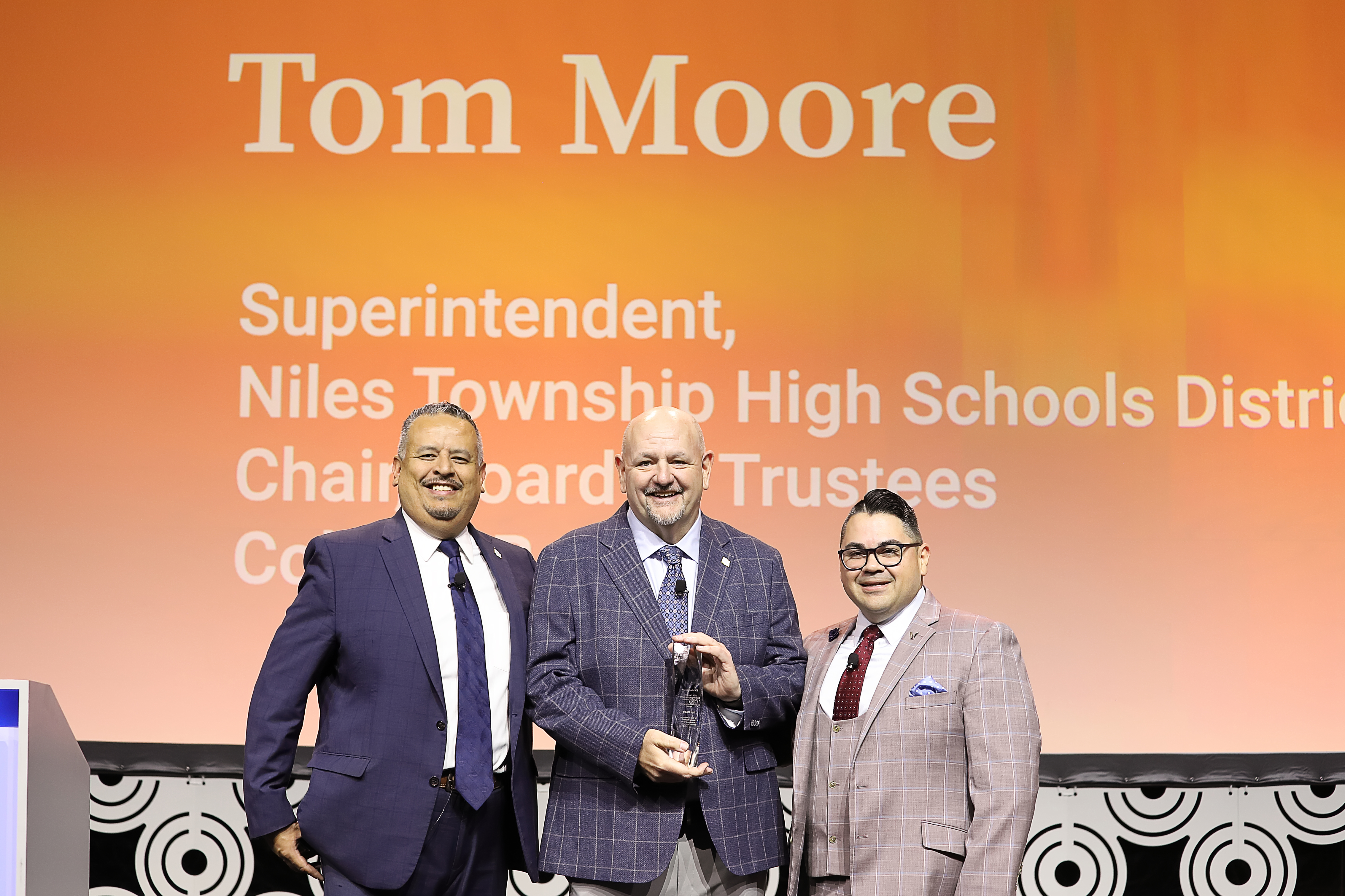
Superintendent Tom Moore (center) receives the Modelo de la Comunidad Award from 2026 Prepárate Conference co-chairs Luis Narváez Gete (left) and Daniel Villanueva (right).
Fresh off receiving the College Board Modelo de la Comunidad Award for advancing educational opportunity at Prepárate™, Tom Moore has much to celebrate. He has served as chair of the College Board Board of Trustees since 2022 and is the superintendent of Niles Township High Schools District 219 in Chicago, Ill. In this interview, Tom reflects on family, education, and leadership, sharing the moments that have defined his path and continue to guide his impact.
Q. You mentioned you were the youngest of seven. What was that like growing up?
A. I was the youngest of seven. It was the 1970s, so there wasn’t the same kind of safety net. My dad was a plumber and pipefitter in Local 12 in Boston. That was really the backstop for our family. He hurt his back in 1976. My mom stayed home—we were a traditional Irish Catholic family—and things were a struggle.
I remember the orange blocks of government cheese and powdered milk. I still can’t drink whole milk because it tastes too thick. I drink skim to this day.
But I never felt like we were doing without. I had six siblings—there was always someone to play hockey with, go sledding with. My older brothers and sisters showed me everything.
What I did notice was opportunity. I’d see other kids getting picked and think, Why not me? And sometimes, not my best moment, I’d think I’m smarter than that kid.
If I ever said I was bored, my mom would say, “Read the encyclopedia.” We had the World Book set. My siblings hated that. I loved it. I’d sit there and read it. That’s where my love of history came from.
But I didn’t know the path. I liked learning, but in my family, if you were the academic one, people thought maybe priesthood. As the youngest boy in an Irish Catholic family, that was the expectation.
Q. What about high school? Did anyone help you figure out college?
A. No, not really. I didn’t have anyone explaining how to apply or what to do. I was Mike’s brother, Tim’s brother—that was my identity.
The expectation was was that I’d become a plumber. That’s what the family did.
Then my SAT scores came back senior year, and that was the first time people said, “You can go to college.” I’ve said before, my first time on a college campus was being dropped off.
That stays with you. It’s why I think the schools have to lead. In some communities, parents push. In others, they trust the school. If they trust us, we have to push for their kids.
Q. Did you have a teacher who stood out?
A. Miss Ryan, my English teacher. I had her sophomore year and senior years. She’d give me extra books.
I remember senior year, after I was placed into honors, everyone was talking about where they were applying, and I had no idea. Someone said something negative about me, and she said, “Tom’s going to be just fine. Don’t worry about him.”
I remember thinking, OK—I’m going to be fine. That mattered.
Q. What did you study in college?
A. This is where it gets interesting. I was a Soviet studies major focused on the postwar period. Then the Soviet Union collapsed while I was in college—good for the world, bad for me.
Around that same time, I met my wife. We’ve now been married for over 30 years. She was diagnosed with thyroid cancer at 21, which changes your perspective pretty quickly.
I was thinking about grad school, maybe law school. I took a year and got a job coaching JV baseball at a small school in western Massachusetts.
One of the history teachers gets hurt, and the principal says, “Don’t you have a history degree?” I said yes. She says, “Do you want to sub for six weeks?”
I went in and started teaching history, coaching. I realized I was getting paid to do this. That was it. I went back, got certified, and that became my career.
Q. What did your parents think as this was all happening?
A. My mom was more reserved, but she loved learning. She should have gone to college.
My dad showed it differently. Growing up, I thought we clashed. My brothers would say, “Are you kidding? You’re his favorite. All he does is talk about you.”
He worked outside all day, in the cold, laying pipe, and he’d come home exhausted—but he’d still get into a catcher’s crouch and catch for me. That’s how he showed love.
As I got older, I understood how proud he was. He just wasn’t always verbal about it.
Q. How did College Board come into your life?
A. It really started with teaching AP European History. They asked me to teach it, and I said sure, I’ll teach anything.
I had an unbelievable group of kids. When the scores came back, everyone earned a five. You start thinking you’re pretty good.
Then a colleague of mine, a special education teacher, said, “You’re telling me a kid who loves history can’t take your class?” He was right. He put me in my place.
So we opened it up. Within about a year and a half, we went from 24 students to around 170 in AP European History.
We didn’t lower expectations—the kids rose to meet them.
College Board noticed and asked me to speak about it. My message was simple: We asked kids to take the class, and we believed in them. And I knew them—I coached them. Relationships matter.
Q. As you moved into leadership, how did you stay grounded?
A. Having my own kids go through the system was huge. You see things differently.
You think, if this is happening to my kid, with everything I know, what’s happening to everyone else? That keeps you grounded real fast.
Moving to Illinois helped too. I didn’t know anyone. I had to listen more and build a team.
At some point, you realize you’re not the 25-year-old teacher anymore. When I walk into a classroom now, I change the room just by being there. I can’t connect the same way.
So my role becomes: How do I clear the path for others to do that work well?
Q. What drives you now in your work with the College Board?
A. It gives me a broader lens. I’m not just thinking about my district—I’m thinking about kids everywhere. Rural, urban, all of it.
We talk about the American Dream. What are the pathways?
I think about my dad and my brothers. They were skilled, worked incredibly hard, and did side jobs all the time. They probably could have built their own businesses, but no one showed them how.
That’s why something like AP Business with Personal Finance matters. It’s not just about college. It’s about giving students options they didn’t know existed.
At the end of the day, that’s what drives me: helping students see what’s possible—and making sure they have a real chance to pursue it.


