
A Dream Deferred | HBCU Conference 2026
Seeing the SAT as a ‘Launchpad’ for Student Growth
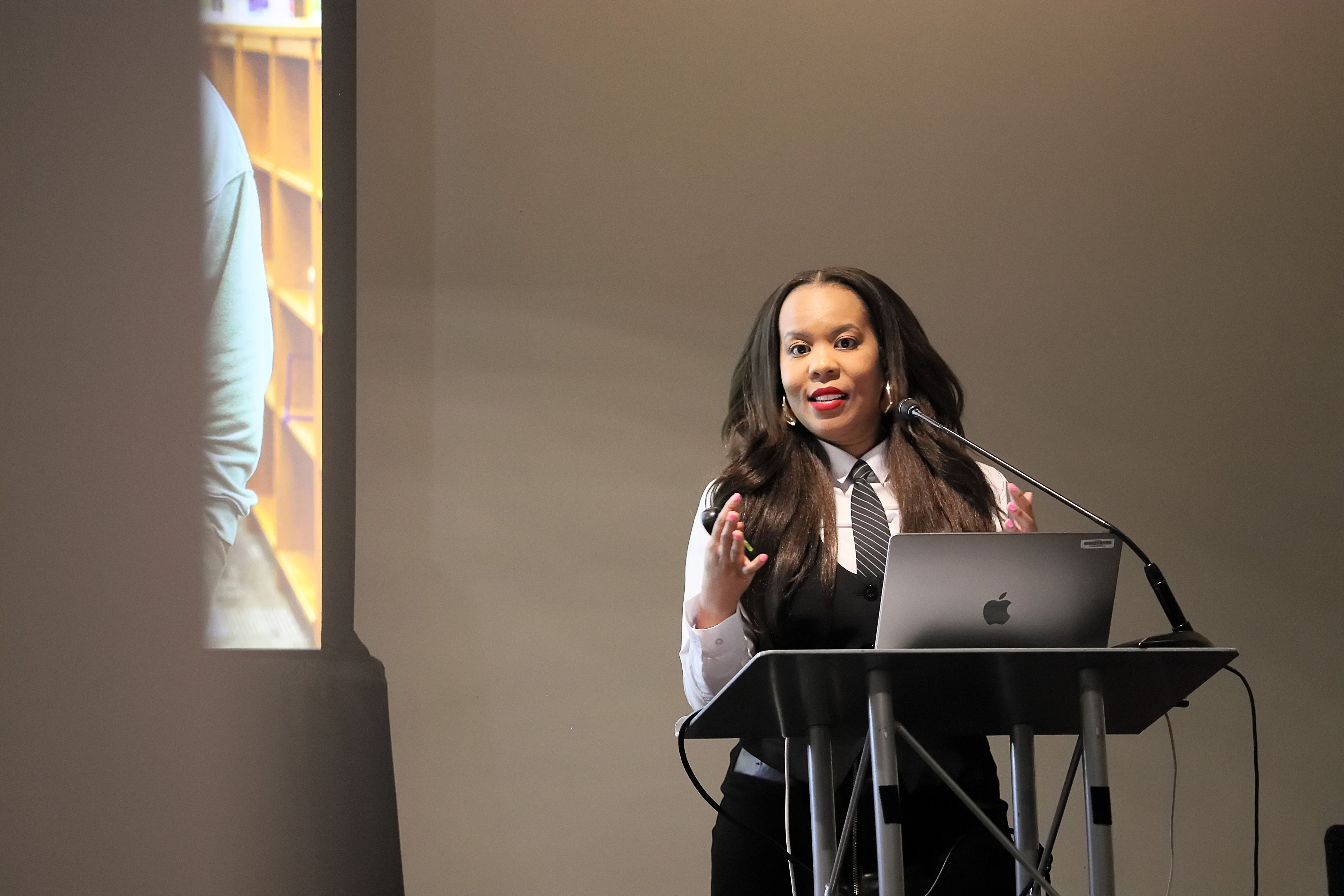
Nicole Gibbs, College Board’s senior director, External Engagement for College Readiness Assessments, presents at the conference.
The SAT can be a powerful tool for growth and opportunity—if students are encouraged to see it that way.
That was the message conveyed by two presentations at the 2026 A Dream Deferred™ and Historically Black Colleges and Universities (HBCU) Conferences. The speakers offered advice to educators to help students get the most out of the exam.
“The SAT is not just a score,” Nicole Gibbs, College Board senior director, External Engagement, said in her session on “The SAT Suite as a Launchpad for College and Career Readiness.” It’s also, she stressed, a vehicle for skill building—including soft skills like confidence and perseverance—and for improving options for life after high school.
A Dream Deferred is an annual conference for educators working to make a difference for African American students. Echoing that theme, Gibbs highlighted the need for schools to help all students today “connect academic preparation to future opportunity,” whether that means college, career, or a combination of both.
As a trusted, research-based measure of college and career readiness skills, Gibbs noted, the SAT can play an important role in this process, especially if students have opportunities for early exposure. In this sense, students have an advantage if their school uses the full SAT Suite of Assessments, which starts with the PSAT 8/9 as early as middle school and moves on to the PSAT 10 before the SAT is given in grade 11.
With educator feedback, earlier practice, and aligned testing opportunities, students can build students’ awareness of where and how they can improve. These experiences can also spark those all-important conversations with advocates and caregivers on their college and career interests and goals, as students begin to ask, “What does this score mean for my future?”
As Gibbs noted, the SAT Suite is designed to boost educators’ insights and capabilities as well. It provides data analysis tools and reports to help teachers and administrators identify learning gaps and design instructional supports. In an initiative planned for this spring, SAT content standards will be integrated into Google Classroom, providing further instructional-alignment opportunities.
Unlocking Opportunities
When students see the SAT as part of a supportive ecosystem, it becomes less of a remote and nerve-wracking one-time event. Gibbs emphasized that College Board provides a range of free practice resources that can help students become familiar with the test and develop their skills. These include full-length practice tests on Bluebook (which Gibbs singled out as the place to start), video tutorials on Khan Academy®, and just-launched peer-tutoring bootcamps on Schoolhouse.world. A new feature offering personalized practice recommendations based on students’ scores will be available later this spring.
Equally important, College Board provides resources to help students directly connect the SAT to their career interests and goals, Gibbs noted. Each student’s score report includes a Career Insights Snapshot featuring a customized list of growing careers in their state, complete with education requirements and salary ranges. Students can also get personalized career and college planning insights on BigFuture.
These resources can pique students’ interest in career options that may not have been on their radar and help them plan next steps. In combination with the SAT, Gibbs said, they empower students to “actualize opportunity.”
Breaking Barriers
But educators can still face challenges in getting students to engage with the SAT.
In a separate A Dream Deferred session titled “Breaking Barriers: Supporting Black Learners to Access Resources and Boost SAT Success,” Brittani Williams, PhD, College Board senior director of policy and advocacy, and Tramelle Howard, director of EdTrust Louisiana, acknowledged the tensions that often surround standardized tests like the SAT in school communities.
During icebreaker and Q&A discussions, participants underscored that even some educators and family members may feel the test isn’t a full reflection of their students’ abilities or the best fit for them.
But Williams and Howard stressed that it’s important for educators not to discount students’ capabilities or the role of testing in their lives—but instead to bring students’ humanity and potential more fully into the learning process. “The goal,” said Howard, “is not to eliminate testing but to use it more effectively.”
For Williams, this means leveraging brain science to build bridges and routines to strengthen students’ “cognitive conditioning” for the test and connect test content to what they already know. Among the approaches she recommended were:
- Study early, study often. It’s critical to get early benchmark data—via practice tests or the PSAT 8/9, for example—to know where students need support, Williams emphasized. Equally important is giving students early and regular exposure to sample test content so that they “get into the habit of seeing how the tests are written.” The SAT Question of the Day feature and Official SAT Prep on Khan Academy are key resources for this.
- Build testing stamina. In many ways, Williams said, the SAT is as much a test of mental endurance as of academic skills. Students need opportunities to practice focusing mentally for close to 3 hours. Williams recommended that students sit for at least 2 to 3 full-length practice tests prior to testing. Before that, it can be helpful “to stairstep their way in” by setting aside extended focus time for pleasure reading, writing, or even just doing a puzzle.
- Honor linguistic difference. Students need to know that in helping them prepare for the test, you’re “not trying to change them but to add what they already have inside of them,” Williams said. This means treating their own ways of speaking as an asset and “teaching academic language as an expansion of their skills.” To be at their best cognitively, students need to feel that they belong and are “secure in who they are.”
- Develop fluency and recall. Students need ways to help them internalize foundational skills and procedures so they become automatic during testing. Williams advised having students answer questions without notes, explain reasoning aloud, and write from memory. Explicit instruction, repetition, and consistent, targeted practice are also key—Williams and Howard frequently used the analogy of teaching kids to play chess. It’s not about taking time away from regular course content, Williams stressed, “but planting the seeds to prepare students.”
- Foreground tutoring. Howard added that intensive, small group instruction can be highly effective to help students boost or regain specific academic skills. In this light, he called attention to the Schoolhouse peer-tutoring SAT bootcamps. “Part of breaking barriers for Black students is just information,” he advised, so they know what’s available to them and have the same opportunities as other students.
“Ultimately," Williams said, “the SAT is a stepping-stone to postsecondary success”—one that is open to all students. With that in mind, she concluded, it’s essential to shift the conversation from “Why aren’t students performing?” to “What conditions can we create for performance?”
When she was a teacher, she added, she didn’t bother to tell her students the SAT was optional in many cases. The benefits of taking it, both financial and academic, were just too great.


