A Dream Deferred | HBCU Conference 2026
How AP African American Studies Builds Access and Rigor
For some students, it’s relatively easy to access advanced-level coursework in high school. But for historically underrepresented students, those same opportunities often feel out of reach. Over the past 10 years, this narrative has begun to shift.
That was one message conveyed in a session on “Using AP® African American Studies to Build College and Career Readiness” at the 2026 A Dream Deferred™ and Historically Black Colleges and Universities (HBCU) Conferences.
There is a misconception that this course is one that’s rooted in ideology. However, this course is rooted in history.
Markeela McGill, Director of Implementation, West Coast, College Board
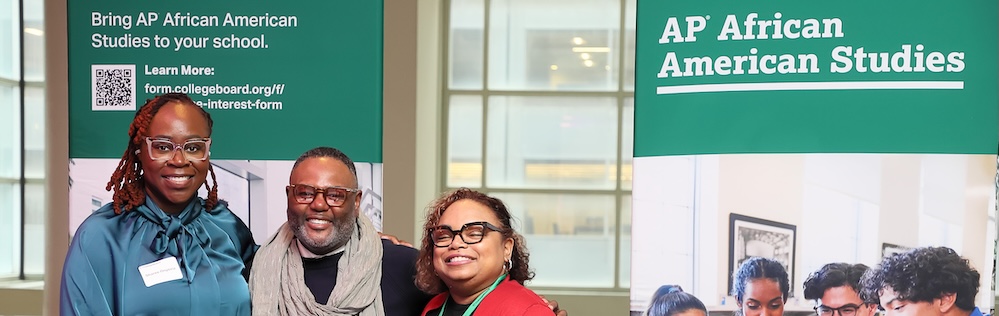
Led by Markeela McGill, director of implementation, West Coast, College Board, and Caleb Wooten, dean of College Readiness & Advising at The SEED School of Los Angeles, the session examined which students get access to AP courses, the appeal and depth of the new AP African American Studies course, and what happens when underrepresented groups have the opportunity to take college-level coursework.
To ground the conversation, Wooten shared key data points about AP access nationwide:
- 35.7% of U.S. public high school graduates in the class of 2024 took at least 1 AP Exam.
- 75% of Black students attended high schools offering 5 or more AP courses.
- However, Black students have had the second lowest growth in AP participation in comparison to other racial and ethnic groups.
“Availability and access are two completely different things. A course can be available, but students might not have access to it,” Wooten noted. From 2015 to 2025, Black student participation in an AP course increased by only 2%, which begs the question: Why?
Participants were asked to reflect on:
- Which students are encouraged to enroll in AP courses?
- Which students see themselves reflected in the curriculum?
- Which students believe they belong in rigorous spaces?
The key takeaway from these prompts: “If AP is important, equitable access must also be intentional,” said Wooten.
SEED LA AP Success Story
Located in South Los Angeles, SEED LA is a public, tuition-free, college-preparatory boarding high school that currently offers 14 AP courses. Wooten highlighted the impact of the school’s holistic model on student success.
- 83% of students in grades 10–12 have taken at least 1 AP course
- Students received over $12 million in institutional aid and scholarship
- For the class of 2026, 97.6% have passed an AP course, and 90.4% have passed multiple AP courses
Among all the AP courses offered, AP African American Studies was the most popular and well-reviewed class. It also fulfills multiple requirements, including the University of California’s (UC) A-G subject requirements and the California Department of Education’s ethnic studies requirement.
A Course Designed to Benefit All Students
“Students across a wide variety of interests are going to find themselves engaged within this course framework,” McGill said of AP Af Am. As an interdisciplinary course, AP Af Am is intentionally designed to bridge various points of student interest—from the arts and humanities to geography and science.
It’s also thematic, making connections for students across chronological units ranging from 900 BCE to the early 2000s, exploring the origins of the African diaspora through contemporary movements. McGill emphasized that this scope is meant to show a richer, fuller narrative of the African American experience beyond enslavement and oppression.
The course focuses on three core academic skills:
- Applying disciplinary knowledge to build foundational understanding for an introductory level African American studies course.
- Source analysis, allowing students to develop analysis skills of over 250 primary and secondary written and multimedia sources.
- Argumentation, specifically building writing skills, so students can construct sound arguments and develop claims based on evidence.
These skills are honed across the four units of the course, culminating to a final project-based assignment, allowing students to demonstrate and apply their learning.
Amplifying Student Voices and Experiences
I would recommend this course because it helps students feel seen, heard, and empowered.
Lonyah Flowers, SEED LA Class of 2026
As Wooten noted, AP Af Am is a popular course at SEED LA. Seniors in the class of 2026 were able to share their experiences of the course, reflecting on how it influenced their college and career pathways, connecting what they learned to future goals, and exploring their own personal identity. Wooten shared some of their responses:
- “This course taught me that I didn’t just come from slavery. I also came from kings and queens.” Jaden Frazier
- “AP African American Studies was the first AP class I ever took. It motivated me to take more AP classes.” Devin Williams
- “Before taking AP African American Studies, I would constantly doubt myself and the abilities I have in school. After taking AP African American Studies, I’ve come to realize I’m doing exactly what I need to do!” Kenya Tucker Okasisi
Data Tells the Story—This Course Works
Since launching nationwide in spring 2025 following a three-year pilot, AP Af Am has experienced significant growth. Enrollment in the course increased by over 99%, from 10,780 in 2024 to 21,484 in 2025. This signals that the course is resonating with schools, students, and communities across the country.
Students are not only enrolling—they’re excelling. In 2025, 79% of students who took AP Af Am earned a 3 or higher on the AP Exam. This is proof of student engagement and performance: they’re building confidence, developing essential skills, and seeing themselves as scholars. Additionally, 97% of students feel engaged with the content of this course, and among students new to AP, 94% said they’re now likely to take another college-level course after completing AP African American Studies.
Giving Teachers the Tools to Expand Access
To support teachers in expanding overall AP access, McGill highlighted helpful professional learning supports and training opportunities, including AP Summer Institutes, the online AP Community for teachers, AP Classroom, online AP workshops, and AP Mentoring. Virtual community of practice sessions are also available, where fellow educators share best practices and strategies to support student growth and understanding of the course material.
Wooten concluded the session by offering advice to help educators publicize the course at their schools and make AP Af Am more accessible. “It matters for students to know what’s available... It starts with them feeling empowered and feeling like they belong in the spaces which they’re in.”