Research
College Faculty Weigh in on the Role of AI in Higher Education
New research brief on perceptions of generative AI from more than 3,000 college faculty
When generative AI tools first became widely available, one veteran college professor did what many of us did: he tested them.
Dr. David Miller, professor of English and Philosophy at Mississippi College, fed the system a prompt he had used for years in his introductory English course. The response, he recalls, even in its early iteration, was a solid B or B+ in terms of organization, coherence, and content.
For college faculty across the country, that moment of recognition has given way to something that is often mistaken for blanket resistance but is more complicated: uneven experience with AI, varied degrees of AI disruption by academic discipline, and a sector still working toward shared policies.
College Faculty Perceptions of Generative Artificial Intelligence in Higher Education is the third brief in a new research series on generative AI use, sentiment, and its relationship to student learning and outcomes. The brief draws on responses from more than 3,000 college faculty at roughly 1,000 institutions nationwide.
AI Variation Across Disciplines
A key contribution of the survey to the growing evidence base is that the impact of AI varies by academic field.
Faculty overwhelmingly report that students are using AI for writing-related tasks. It’s not surprising that faculty in disciplines that rely more heavily on out-of-class writing assignments report the highest levels of student use.
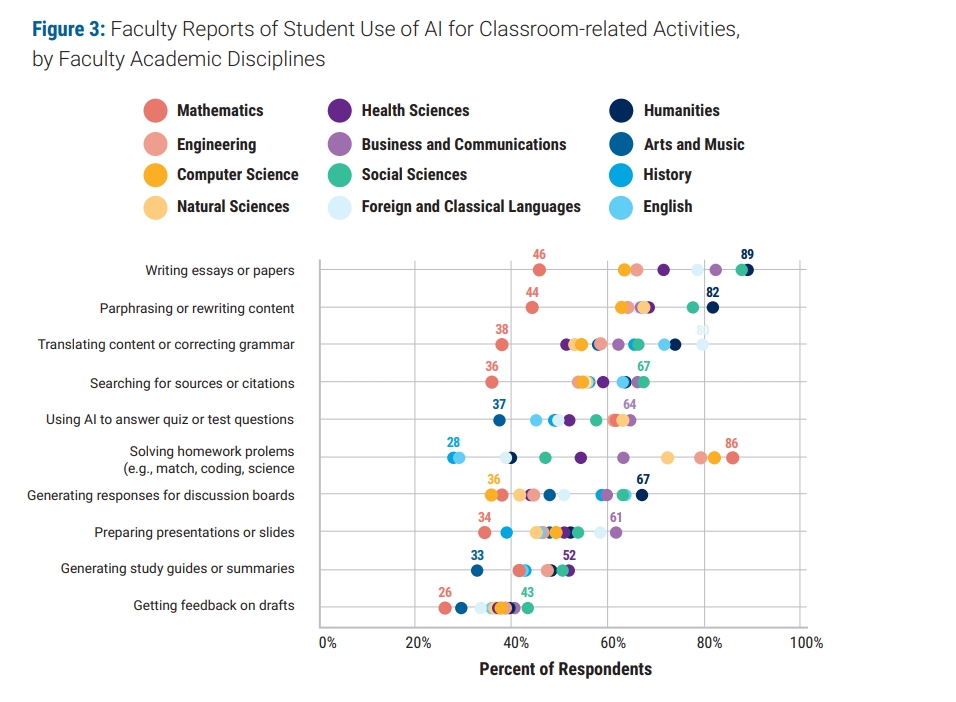
Nearly three-quarters of faculty report facing at least minor challenges managing student use of AI in their classrooms. Faculty in English, humanities, and social sciences are among the most likely to describe moderate or significant classroom disruptions compared to faculty in mathematics, engineering, and health sciences.
However, AI student use is not restricted to writing activities. College faculty in business and communication report student use of AI in preparing presentations, and those in mathematics and computer science report use in problem-solving activities.
Exposure is Influencing Opinion
If there is one broad area of agreement, it’s concern. Forty-five percent report a somewhat or very negative view of AI in higher education, with more than 9 in 10 faculty reporting at least some level of concern about plagiarism and dishonesty related to AI use.
At least 84% of faculty agree that AI tools make students more dependent on technology and less likely to develop critical thinking skills, express original ideas, or engage deeply with course material.
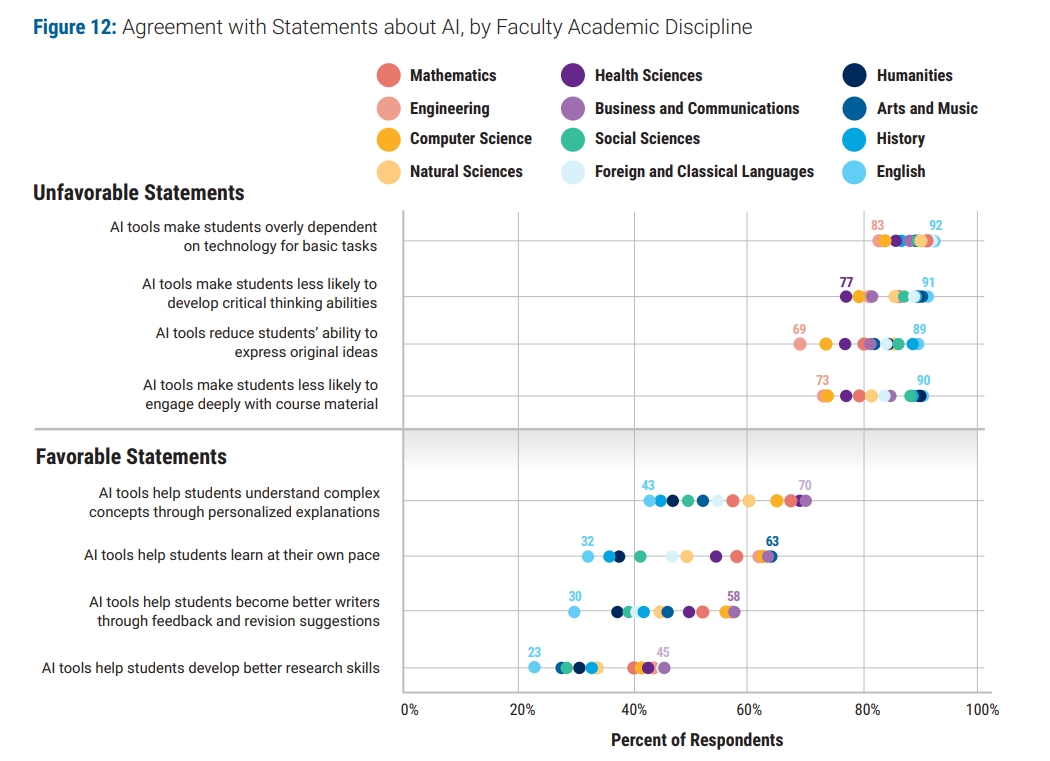
Yet, roughly one-third report a positive view and faculty who experiment with AI themselves tend to hold more favorable views than those who have not.
Professor Miller acknowledges that not all college faculty will embrace AI, but there is a notable difference between informed skepticism versus unfamiliarity guiding decisions and perspectives. Without opportunities to test these tools, faculty are left forming policies in the abstract..
The data shows that at least two-thirds of faculty say they have used AI in their work in some capacity, but few are using it deeply. Only about one in five say they feel very confident in guiding its use by students.
This mix of skepticism and exposure may explain why campuses have not settled on an approach. Half of faculty report having a formal classroom policy on AI use, while less than a third provide informal guidance.
The Future of Learning
Over his 35-year career, Miller has watched the research process evolve from card catalogs to online databases to Wikipedia and now to generative AI. Each moment, he says, prompted the same question: What skills are foundational, and which are artifacts of an earlier era?
"When Wikipedia came along, people said research was over," he recalled. "It wasn’t. It just changed how we needed to teach the students. We had to ask, 'What thinking skills do they need now?' The more fundamental question we should be asking is how can we move away from rote, mechanical assignments and engage students more directly with what they are studying? What habits of mind, what forms of judgment, what modes of thinking do our students need, and as an educator, how can I rethink my assessments to make sure I'm seeing those happen?"
As college student adoption of generative AI outpaces the consensus among faculty leaders, higher education needs evidence-based policies and practices. These policies should encourage innovation while protecting core learning goals and preparing college students to succeed in workplaces where AI is part of the landscape.
The brief is part of a series on generative AI in education. Access the full series here: Technology and Learning – Research | College Board