Civics@Work
Civics for the Next 250 Years
What comes to mind when you hear the word civics? Most people might think back to memorizing U.S. history facts or learning how elections work. For me, I remember my parents’ experience with the U.S. naturalization process. Together, we spent many nights at the dining room table quizzing one another about the branches of government, the Bill of Rights, and other facts I recalled from my K–12 days. All the while I couldn’t help wondering: Is this what it means to be an American citizen?
Building a foundation of knowledge will never lose its place in civics education. But if my time in the classroom as both teacher and student taught me anything, it’s that students crave learning experiences that connect to their real lives. New College Board research sheds light on the ways young people are looking to engage in civic life. We know that adolescence is a peak time for young people to form civic attitudes and behaviors, and this research informs organizations seeking to connect civics education with real-world experiences. As the country is celebrating its 250th year, I sat in a room last month full of people thinking about what the future of civics should look like.
U.S. Chamber of Commerce
Civics@Work and Everywhere Else
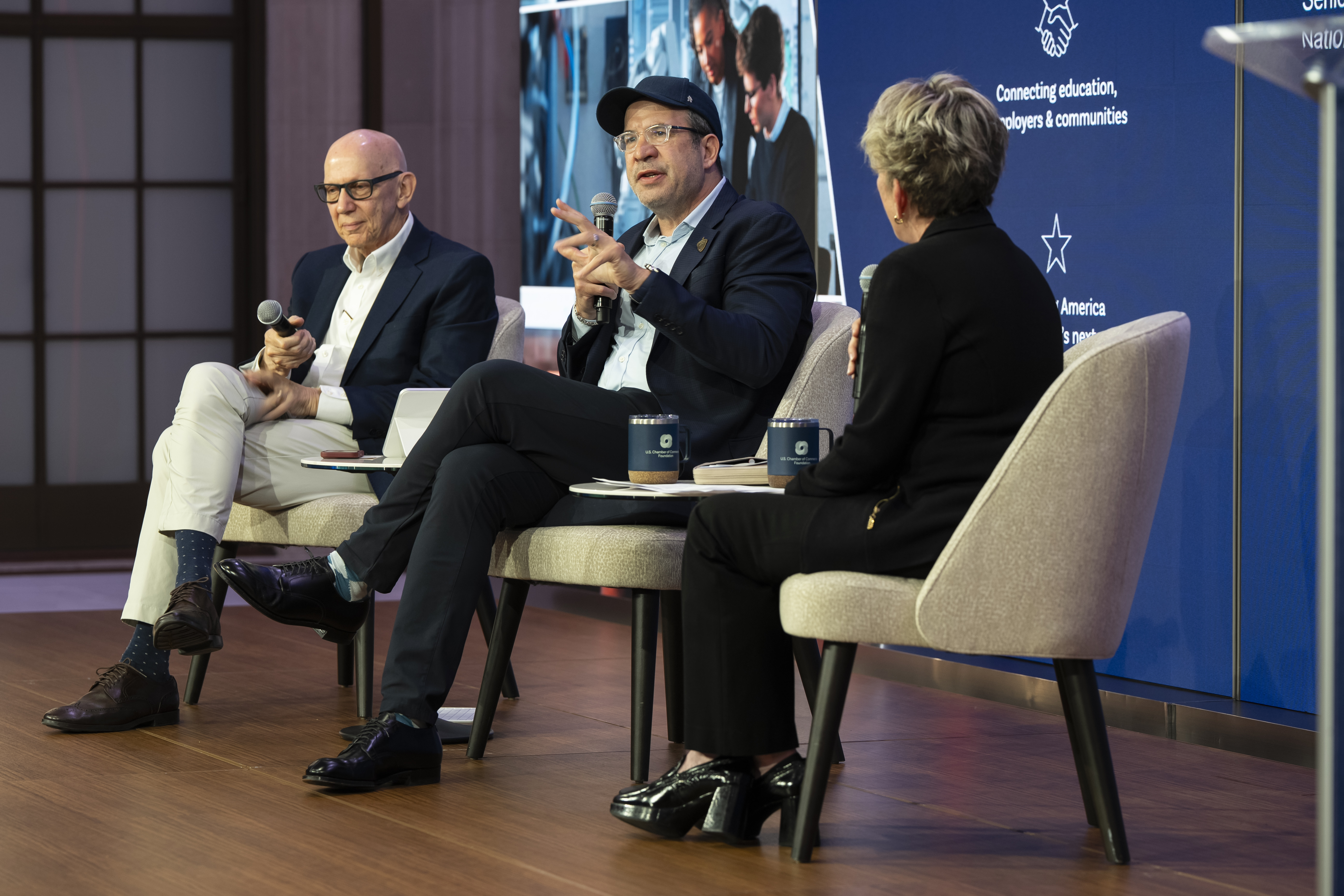
This past Constitution Day, College Board and the U.S. Chamber of Commerce Foundation co-hosted Skills for America’s Future: A Civics@Work Forum, an event that highlighted the connection between civics and work. Policymakers, employers, and education leaders spent the morning on an essential question: What does the next generation need in order to thrive at work and in their communities?
The clearest answer came from the youngest people in the room. In a student panel, now featured on C-SPAN, three students spoke about their civic journeys. Emily Brubaker, a high school student from Alaska and a National Civics Bee champion, started advocating for rare-disease healthcare at her state capitol as early as 6 years old. Both her Alaskan and rare- disease communities are a hub of support as she develops her voice in the advocacy space. Caden Hartman, now a student at George Washington University, found his spark as a Senate page and volunteered with legal aid after the 2025 tornadoes in St. Louis, helping neighbors apply for assistance. Georgia Clark, a high school student from Iowa and fellow National Civics Bee champion, pointed to the support she received from her own community as the reason she started developing a civics education curriculum for elementary students. None of them described civics as something that happens alone. All three spoke about their desire to know the people around them and to get involved at the local level, without feeling they must save the world.
What the Research Tells Us
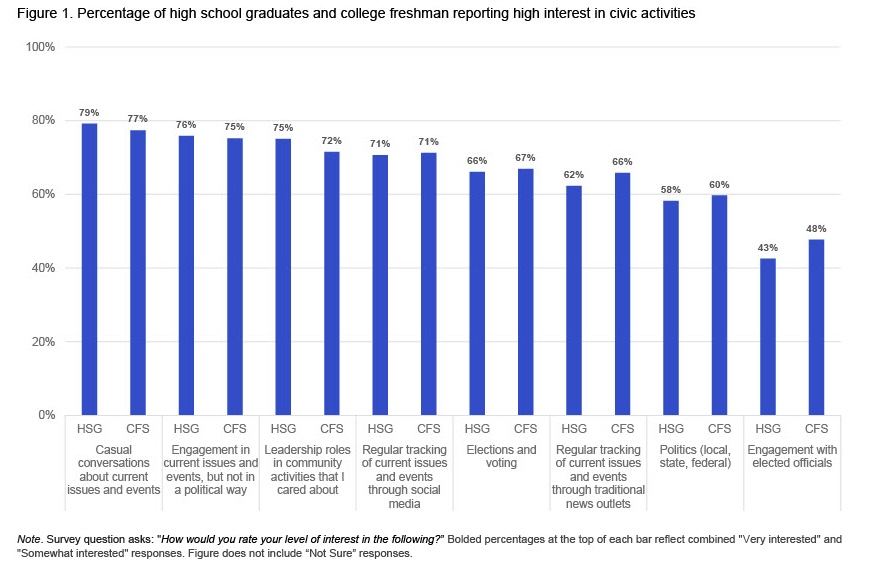
The students on that panel aren't outliers. New College Board research surveyed about 47,000 members of the high school class of 2025 at graduation, and roughly 17,500 members of that same cohort again as college freshmen in 2026. The results push back on the familiar story that young people are checked out.
About 3 in 4 high school graduates and college freshmen (72%–79%) reported high interest in community leadership roles and in conversations about current events, even outside a classroom or club. Students are looking for spaces to engage with current events, but where interest falls off is formal politics. Only about a third of high school students and a quarter of college students expressed high interest in formal political activities. Interest in engaging directly with elected officials sat at 43%–48%.
This differs from how older adults engage with political life. About 2 in 10 adults under 30 follow U.S. politics “extremely” or “very” closely, compared to 45% of adults 60 and older according to a 2025 AP-NORC poll. Yet the preferences for strong local and community interest echo a much older ethos. Early American political thinkers may have traced civic vitality to local associations and direct, small-scale involvement rather than national political participation.
At the same time, young people today may express different civic interests but still see classroom activities as playing a key role. Among high school students, 76% agreed that their coursework prepared them for a future career and taught them how to be a good citizen, and 81% said it taught them valuable life skills. This tracks with what we see in AP course taking. AP U.S. Government and Politics is one of the favorite courses based on surveys of AP students from the past two years. From the range of courses offered, students are choosing one where they learn about political participation.
Civics and Business Go Together
Civics education can also be about more than just learning what government can do. College Board CEO David Coleman and Henry Doss, CEO of Right to Start, spoke on a panel about the false conflict between career readiness and civic preparation. In his remarks, Coleman shared that “civics without business is a shadow of what’s possible” because it reduces a person’s autonomy to just what they can do as a voter and not what they can pursue through their own earnings and interests. Negotiation, agency, and tolerance for failure are all business habits and civic habits at once. This is one reason College Board launched AP Business with Personal Finance this fall, adding to existing courses like AP U.S. Government and Politics, AP Seminar, and AP Research.
Business and civics was a common thread throughout the day. Speakers ranging from Michael Carney, president of the U.S. Chamber of Commerce Foundation, to Sal Khan, founder and CEO of Khan Academy®, discussed that in a rapidly changing technological and workforce landscape the most durable skill is the ability to think for yourself. The ability to talk to people who think differently and to discern accurate information are exactly the kinds of civic skills that are needed now. Khan also spoke about how the one thing we can't afford to lose is the most American thing about us: dynamism, the idea that where you start doesn't decide where you end up.
That idea is my parents’ story. The facts I quizzed them on at the dining room table mattered; they built a foundation for their knowledge of U.S. history and a curiosity about their civic duties. But at the heart of their journey to become citizens was choosing to engage in a community different from where they grew up and finding their own meaning in that process. The future of democracy and civic learning relies on this engagement.