
APAC 2026
AI Classroom Integration: The Role of Disciplinary Thinking
Teachers are being asked to make decisions about generative AI use in their classrooms with very little settled evidence to lean on. According to Stanford SCALE’s 2026 review of research on AI in K–12, only about 20 of some 800+ studies produced any causal evidence, and a widely cited meta-analysis of AI’s impact on learning was recently retracted. This leaves educators without definitive guidance and evidence needed to make informed judgements on improving student learning with generative AI (gen AI).
What happens when AI integration in a classroom starts with a teacher planning for the interplay between students and core disciplinary thinking?
Educators at the 2026 AP Annual Conference explored that idea in a session on designing for disciplinary gen AI integration that proposed a process for deciding when, whether, and how gen AI may belong in a student-facing learning experience.
The advantage to a disciplinary approach
Large language models are excellent at pattern recognition, but using them to do so in a statistics context as part of cleaning data isn’t the same as using it in an art and design context, where patterns in an artist's outputs communicate and evoke human emotion. Creating an AI-assisted lab report in a science classroom, primarily focused on reporting experimental observations, may not trouble educators the way an AI-assisted literary argument would.
As the field continues to understand the impact of gen AI, Justin Reich from the MIT Teaching Systems Lab argues for a focus on the practices of disciplinary experts.
This disciplinary grounding is a practical way to think about protecting learning while making use of the affordances of technology. Teachers are best placed to make these determinations—grasping both what the subject demands and how students need to interact with the content to develop competence and understanding.
Design sprint: Putting the instructional model into action
When evaluating how teachers, students, content and AI might interact, a teacher is the human in the instructional loop, designing the interaction and evaluating what students learn. The discipline sets the boundaries for where AI can be utilized in a way that doesn’t interfere with learning, while students work with an AI-supported task the teacher has shaped.
In the session, AP teachers were asked to design an AI-integrated learning experience for an academic subject of their choosing. They were provided a set of key considerations to reflect on as they started their task design. The key determinants were if a task:
- Protects productive struggle, meaning students are responsible for doing the heavy lifting of learning.
- Connects AI to core disciplinary practices, meaning student AI use is tailored to the discipline in which it is deployed, and build on evidence-based teaching practice, meaning AI use aligns with established best practices for teaching and learning in the discipline.
- Ensures independent mastery, meaning AI-supported learning doesn’t interfere with how students will perform when they are assessed without the technology.
- Proactively addresses access considerations so existing digital divides are not exacerbated.
- Maintains clear guidance on acceptable use, meaning there are unambiguous policies and use cases.
What teachers built
Teachers picked a single objective from their course, described the thinking it demands, decided what AI should and should not do, and worked out the specific moves for the teacher, the student, and the AI.
Take AP U.S. History, where students are asked to judge what a historical document can and cannot prove Analysis should be student led, and AI is deployed as a "rival reader" that pushes back on student reasoning after they have made their judgments, arguing the source proves more, or less, than the student allowed. In the example, AI wouldn’t supply the sourcing analysis or the background context, because this historical reasoning and evaluation is an important skill to be developed in the discipline. Technology, deployed in this manner, can strengthen student development of that skill through practice and deepening of their justifications.
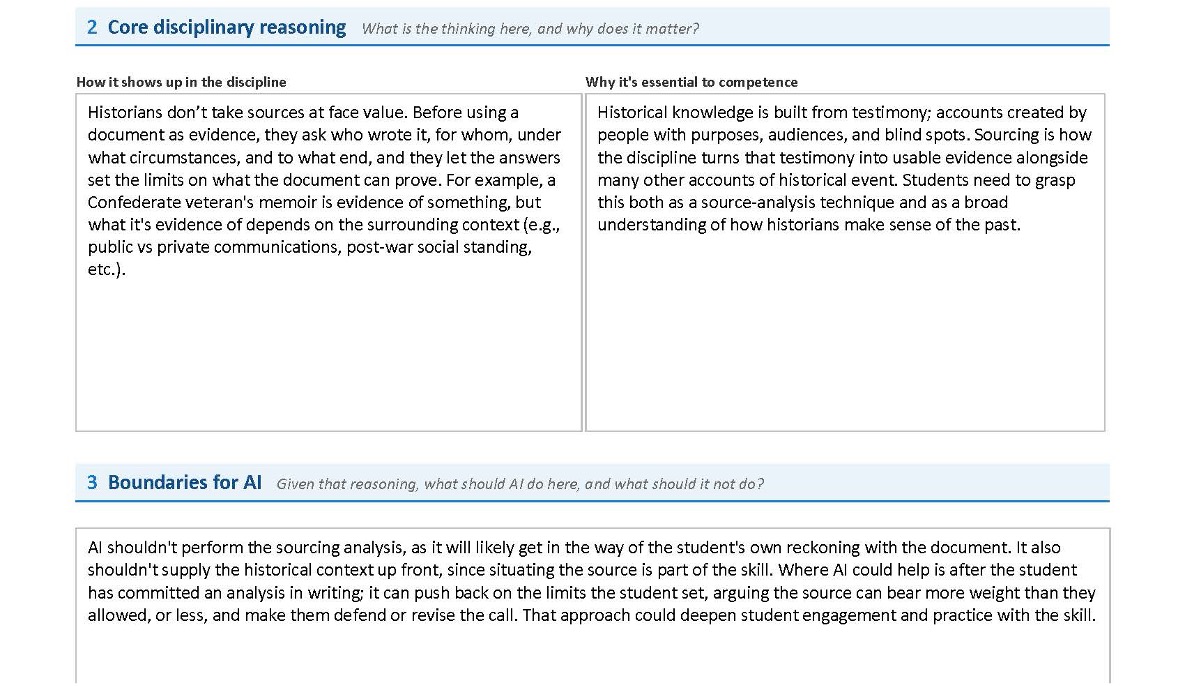
Sample of the design sprint when applied to an AP U.S. History task.
Another design for AP English Literature was focused on forming and defending an interpretation with evidence from the text. The teacher drew a firm line: AI would not generate any writing a student could pass off as their own. Instead, after students wrote their own paragraph on how the setting in a novel reveals a character's inner conflict, a teacher-monitored AI would respond against the teacher's own rubric with feedback, pushing the student's reasoning further without rewriting the work itself. Students would then reflect on the feedback and revise. In this example, AI was put in the role of a coach and the writing, and the thinking remained student led.
Where we go from here
The disciplinary approach to AI integration was well received by attendees, but educators still face practical issues, and this approach doesn't erase those pressures or address the need for longer-term evidence on AI and learning. Students and families are not uniformly comfortable with AI in schools, and the education field is in the midst of a wider public reckoning about screen time and technology. Decisions around AI integration happen inside schools, districts and communities that may not be ready for it, even as the technology continues to transform the world students will inherit.
It raises a practical question: How can educators help their school communities make good decisions about integrating AI in safe and meaningful ways?
Focusing on the core content knowledge and skills that students need to develop, and building AI-enabled learning around supporting those goals ensures that teachers are in the loop and students are still responsible for the heavy lifting of learning. Attention to disciplinary thinking provides a path for AI integration that can enhance and protect opportunities to learn, and educators can set the stage for success as they carefully plan for where students lead and AI follows.